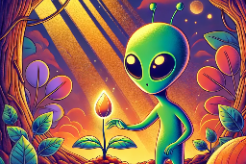
Recently we were called a hypocrite. At first that stung — and then I felt oddly grateful. Gratitude because those comments did exactly what this project aims to encourage: they sparked a conversation, held us accountable, and pushed us to do better. In this article I want to walk you through the full story behind our decision to use AI-generated images in some episodes, the environmental and ethical thinking that guided our choices, the math behind those decisions, and the changes we plan to make going forward.
This post is written to be transparent, to respond to the questions and critiques we’ve received, and to invite the community to shape the future direction of Aliens Love Earth. Whether you’re an artist worried about the future of creative work, an environmentalist curious about the carbon cost of AI, or a supporter of indie projects trying to make an impact, there should be something useful for you here.
Table of Contents
- Why we used AI images: the real constraints and the honest alternative
- Mission clarity: art, ecology, and our promises
- Environmental impact: the numbers that shaped our choice
- Addressing the “stealing art” critique
- Using AI as a bridge, not a replacement
- How the criticism hit and how it changed us
- Practical changes we’re making now
- AI isn’t an off/on switch — it’s a dimmer
- How you can help shape the future of this project
- Measuring and offsetting our footprint
- FAQ — Questions we’ve been asked (and honest answers)
- Final thoughts: imperfect choices, continuous improvement
- Credits and acknowledgements
Why we used AI images: the real constraints and the honest alternative
At Aliens Love Earth our heart is to put indie musicians and the planet first — to heal the Earth with art and create a welcoming space for everyone. That mission is non-negotiable. The reality, however, is that we are an indie project running on a beautifully minimalist budget. We dream of working with illustrators whose work moves us, but their rates are valid and, for a small project, often prohibitive: commissioning one piece could consume most of our production funds for an entire season. Those are the hard facts.
So when we plan a new episode we face three choices:
- Let the idea fade and lose momentum;
- Use AI to help bring visuals to life;
- Wait for a money tree to sprout in the garden (spoiler: we don’t have one).
We chose option B: AI-generated still images to accompany the episode audio. Why? Because it allowed us to keep sharing stories that matter. Silence — not publishing — would have meant that people who told us our episodes inspired or helped them would receive nothing. It would also halt the tiny but tangible benefits we already aim to give back to the planet. For that reason I will gently wear the ironic label if it means continuing to create content that nudges people toward mindful choices.
Mission clarity: art, ecology, and our promises
We didn’t make this decision lightly. Our project pledges are clear and public: for every new follower across our channels we restore one square meter of ecosystem. We plan to invest 50% of our profits into ecosystem restoration when profits arrive. We’re actively exploring turning Aliens Love Earth into an official nonprofit so the benefits can be fully dedicated to healing the Earth through art.
That mission informs every decision we make, including how we choose visuals for episodes. If AI is part of our workflow, it must be used in ways that align as closely as possible with our environmental and ethical goals.
Environmental impact: the numbers that shaped our choice
One of the main criticisms we received was environmental: data centers are energy-hungry, so using AI can be damaging. We agree — that’s real. That’s why our choice was not between “AI forever” and “human artists forever”; it was about selecting the lower-impact option between AI-generated video and AI-generated stills, and measuring the real footprint of our approach.
To be as transparent as possible, here’s the research and the back-of-the-napkin math we used to guide our decision. The figures below are drawn from public reporting, including an investigation by MIT Technology Review and other sources that estimate energy consumption for generative models.
- A newer generative video AI model uses roughly 3.4 million joules — about 0.944 kilowatt-hours — to create a five-second piece of video. That’s nearly one kilowatt-hour for every five seconds of generative video.
- Compared to generating a single high-quality image, that same video workload is more than 700 times more energy-intensive.
Put into practical terms:
- Five seconds of generative video ≈ 0.944 kWh.
- One minute of generative video ≈ 11.33 kWh.
- A seven-minute episode rendered as generative video ≈ 79.3 kWh.
So if we were to produce our seven-minute episode with full generative video, that would be almost 80 kWh per episode.
By contrast, image generation is dramatically cheaper. Based on the same sources and our usage:
- Generating 1,000 images ≈ 2.9 kWh.
- We used about 130 images for a typical episode (including retries and replacements), which translates to roughly 0.38 kWh per episode for image generation.
That math leads to a striking point: with still-image generation we could produce roughly 266 episodes before using as much energy as one seven-minute generative video episode. That’s why we consciously chose still images and subtle camera movements/zooms instead of full generative video.
Yes, AI image generation still consumes energy and water. We calculate our entire footprint annually — including episode generation — and compensate for it at year-end. But when comparing the alternatives, stills were a far smaller footprint than synthetically rendered video, and they allowed us to keep producing content that supports artists and ecosystems.
Addressing the “stealing art” critique
Another serious criticism was that AI “steals” artists’ work. To that charge I want to be very clear about our process and intent.
We did not scrape random images off the internet or prompt the model to “create in the style of” identifiable living artists. That kind of approach would be disrespectful and raises real legal and ethical issues. Instead, we used AI tools guided by assets that belong to us or to artists we commissioned and paid for. We provided the AI with our logo and artworks that were either created by our team or purchased/licensed from artists we compensated.
That doesn’t make our approach ethically perfect. AI systems, datasets, and licensing practices are evolving and many questions remain unanswered. But we tried to use AI in a way that reduced harm: leveraging owned and licensed assets to create consistent visuals that complemented the audio storytelling, while actively planning to move toward more human-made art as funding allows.
Using AI as a bridge, not a replacement
Our philosophy is simple: use technology as a bridge so the project can grow to a point where we can hire unique human creators. AI has helped with consistency and speed, which allowed us to keep momentum. The long-term goal is to employ more human artists — people who make unique, soulful creations that a model cannot replicate.
How the criticism hit and how it changed us
One comment in particular left a mark: it labeled our work “actually insane” because of the irony of promoting eco art while using AI. The commenter outlined environmental concerns and the feeling that artists are being hurt by these technologies. It stung because I have invested a lot of time and some money into this project to do the opposite — to support the planet and the creative community.
Restore 1m2 of ecosystem with 2 clicks for FREE |
Subscribe to our YouTube through the link below and we’ll restore 1m2 of ecosystem where it’s needed the most for free. Simply click below and click subscribe when prompted after. The earth thanks you 💚🌍 |
| RESTORE 1m2 NOW |
It’s important to say that feeling hurt doesn’t mean defensive dismissal. On the contrary: we welcomed the call-out. It led to real self-reflection and concrete decisions to alter our approach. Criticism is a powerful tool when it’s used constructively, and we want to foster the type of comments that push us to be better — not to silence us, but to sharpen our practice.
For the record: the alternative wasn’t me suddenly becoming a talented illustrator. My drawing skills are somewhere between a hopeful cloud and a wobbly noodle — which means the realistic alternative was not publishing, not engaging, not supporting the community that told us our episodes were helpful. I choose the imperfect path that allowed the work to continue while I learn and improve.
Practical changes we’re making now
We heard you. We’re acting on it. Here are the practical steps we’re taking immediately and in the near future:
- Prioritize original human-created visuals whenever budgets and logistics allow.
- Continue to use still-image AI (when necessary) rather than generative video to minimize footprint.
- Use owned assets, licensed artwork, and artist-paid content to guide AI where it’s used.
- Calculate and compensate for our carbon and water footprint annually, including episode generation.
- Explore partnerships with platforms and tools that train models only on opt-in art or datasets that respect creators’ choice.
- Advocate — gently and persistently — for tech companies to power AI workloads with renewable energy and more transparent supply chains.
- Increase transparency in our process, share more of the behind-the-scenes decisions, and invite community input before large changes.
- Begin producing more in-person and deeply-researched episodes now that we’re back in our home country and better resourced to film and interview.
AI isn’t an off/on switch — it’s a dimmer
One way to think about AI is not as a replacement but as a tool with adjustable intensity. We can choose how brightly we dial it up, and we can make mindful decisions about where and when it’s used. That includes choices like:
- Using stills instead of full video to reduce energy use;
- Supporting models trained on opt-in artwork and transparent datasets;
- Paying real people whenever possible (designers, illustrators, animators);
- Pushing technology providers toward renewable power and cleaner data centers;
- Being transparent with audiences about when and how AI was used;
- Learning constantly and adjusting our practices as the industry evolves.
How you can help shape the future of this project
We’re a community-driven project and we need your help. If you want to support a small indie platform that intends to put nature and artists first, here are concrete ways to help beyond criticism:
- Recommend or introduce artists whose style and rates might fit our budget so we can commission originals;
- Suggest tools, platforms, or AI services that work with opt-in datasets or that clearly disclose energy use;
- Volunteer skills (editing, design, research) if you have capacity and want to contribute to episodes;
- Follow and engage — for every follower we restore one square meter of ecosystem;
- Donate or fundraise so we can pay artists more and reduce reliance on AI for production;
- Share resources and best practices for measuring and offsetting digital carbon footprints;
- Speak kindly while holding us accountable — we learn more from actionable feedback than from name-calling.
Measuring and offsetting our footprint
We don’t pretend to have all the answers yet, but we have a commitment: we calculate our footprint and compensate for it at the end of each year. That calculation includes:
- Hosting, streaming, and data consumption;
- AI image generation used in episodes;
- Any travel or in-person production emissions related to storytelling;
- Other project activities that generate measurable emissions.
Compensation is done through ecosystem restoration projects and verified offset programs. The aim is to ensure the overall impact of what we do is net positive for the Earth and for the artists we work with. Our long-term vision is to transition to nonprofit status so that every dollar received can be more directly invested into people and ecosystems.
FAQ — Questions we’ve been asked (and honest answers)
Q: Did you “steal” artists’ work to train your AI images?
A: No. We did not feed the model random, unlicensed art from the internet nor did we prompt “in the style of” specific living artists. We guided the AI with assets owned by us or created/licensed from artists we compensated. That said, the entire industry’s dataset practices are imperfect, and we’re committed to improving how we use AI ethically.
Q: How bad is the environmental impact of using AI?
A: It depends on the model, the type of output (stills vs video), and the energy source powering the data centers. Generative video is orders of magnitude more energy-intensive than still-image generation based on current reporting. That is why we used stills and kept the AI usage as minimal and efficient as possible.
Q: Why not just commission human artists from the start?
A: Budget. As a small indie initiative, commissioning professional art regularly would have drastically reduced our capacity to produce episodes and support ecosystem restoration measures. We hope to reach a point where we can hire more human creators consistently.
Q: Will you stop using AI altogether?
A: Not necessarily. We view AI as a tool that can be used carefully and ethically. Our commitment is to reduce its use where possible, prioritize human creators, choose low-footprint options like still images, and always be transparent about our methods. We’ll keep reevaluating as technology, policy, and funding change.
Q: How can I submit an artist recommendation or donate?
A: We welcome artist recommendations and support. The best way to help is to reach out, suggest creators whose rates might align with our budget, or consider donating if you can so we can fund commissioned work and ecosystem projects. Community input is essential to our evolution.
Q: How many square meters do you restore per follower?
A: We restore one square meter of ecosystem for every new follower across our platforms. It’s a small act per person but it scales when many people engage.
Final thoughts: imperfect choices, continuous improvement
“I Promoted Eco Art with AI Generated Images (Here’s What Happened)” is not a tale of perfect ethics or flawless execution. It’s the story of a small, hopeful project navigating real constraints while trying to stay true to a mission that is bigger than any one episode. We made choices — imperfect ones — to continue the work. Criticism sharpened us. Transparency will guide us.
If you’re someone who cares about artists and the planet, this is an invitation to join the conversation. Tell us where we can do better. Recommend artists. Suggest tools or policies. Collaborate. And if our work has helped you, please consider following, sharing, or supporting in ways that keep the mission alive. Every follower helps restore another square meter of land.
Thank you to everyone who called us out with care and to everyone who supports this conscious, messy, hopeful journey. We’ll keep learning and we’ll keep trying to make the output of our work bigger than its cost.