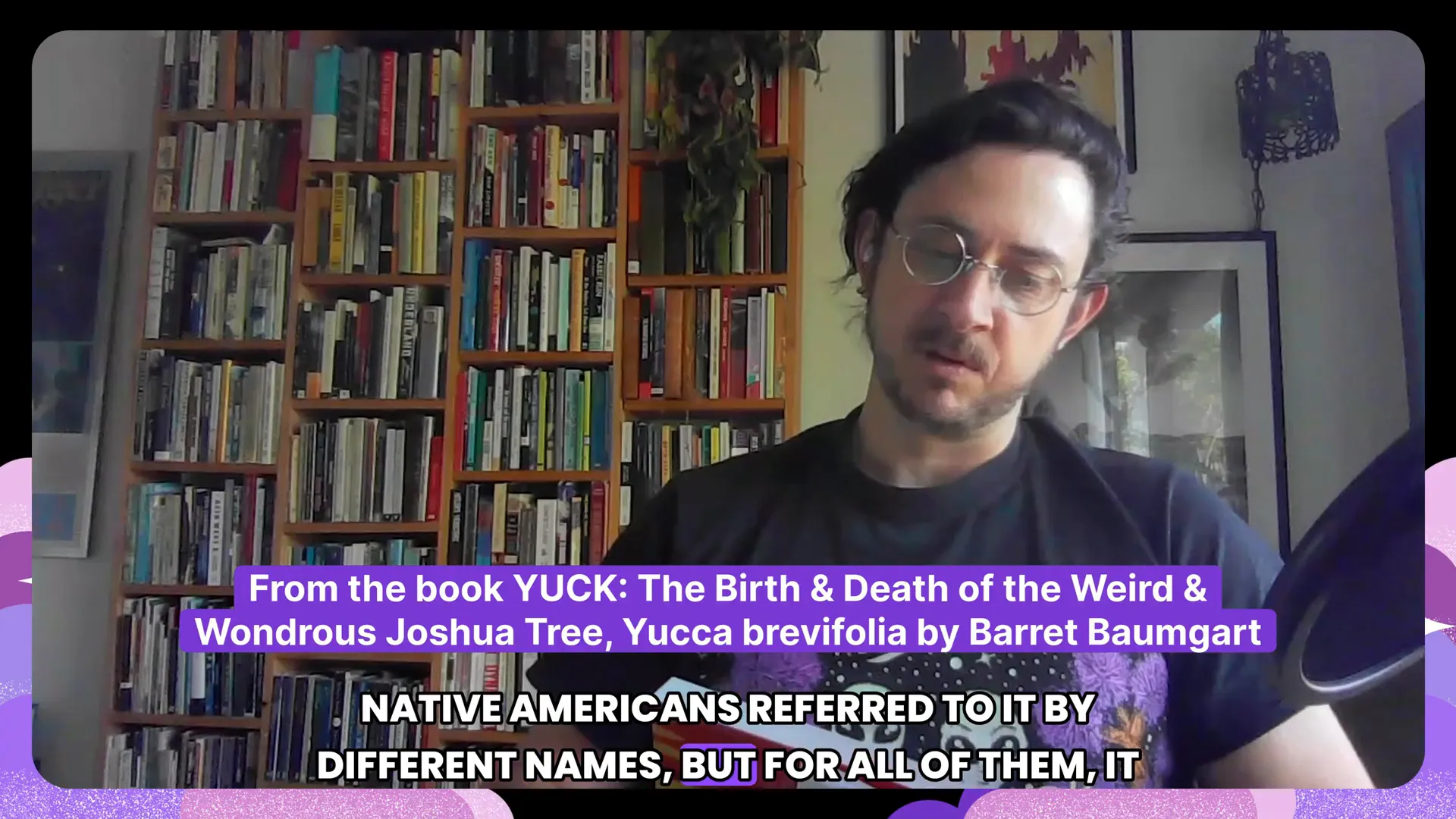
In a conversation that meanders from Victorian vitriol to landfill gardens, Barret Baumgart takes us on a guided tour of one of the American West’s most peculiar and emotionally loaded plants: Yucca brevifolia — the Joshua tree. Recorded by Aliens Love Earth, this interview does more than promote a brilliant, genre-bending book called Yuck: The Birth and Death of the Weird and Wondrous Joshua Tree. It exposes how humans build meaning, assign value, and then reassign it when the social, economic, and climatic winds shift.
The focus keyword for this post is Yucca Brevifolia, the botanical name for the species at the heart of Baumgart’s research. If you care about environmental stories told with curiosity, irony, and a healthy dose of humor — and if you want a close-up look at how culture, capitalism, and climate come together in surprising ways — this article will walk you through the interview’s key ideas, historical oddities, and practical takeaways.
Table of Contents
- Why this tree? How a wedding favor turned into a book
- The early hatred: cultural and aesthetic causes
- From detested to adored: counterculture, spirituality, and Instagram
- Joshua Tree as a microcosm: what the story tells us about humans and nature
- Puente Hill and the afterlife of the Joshua tree: the landfill paradox
- Baumgart’s craft: research, irony, and “a clearing in the forest”
- Music, identity, and transformation
- Truth, persuasion, and the post-truth trap
- Practical lessons for writers, artists, and curious readers
- FAQs (Frequently Asked Questions)
- Concluding reflections: mystery as a resource
Why this tree? How a wedding favor turned into a book
Baumgart’s path to the Joshua tree was humble and human: he was planning a wedding. While scouting venues he noticed that a landscape he’d known for years — Joshua Tree National Park and nearby desert areas — had been transformed by tourism and social media into a curated aesthetic. Wedding blogs, Instagram photos, and a suddenly booming desert wedding industry made turnout and spectacle appear inevitable. A reflex of curiosity — combined with contrarian instincts — sent him down a rabbit hole.
What started as a plan to write a short primer for wedding guests quickly escalated into a deep research project when Barrett found a surprising and sustained pattern in sources: a long, almost gleeful catalogue of contempt for the tree. The more he dug, the stranger the story became. Early observers, surveyors, botanists, travel writers, and poets had given the tree names like “desert dagger,” “monkey puzzle tree,” and “paper tree” — and a succession of adjectives that read almost like an indictment: grotesque, infernal, repulsive.
Then came a twist that kept pulling him forward: what people hate one decade, people commodify the next. Southern Californians who had long loathed the Joshua tree discovered that its fibrous material could be turned into paper — and at the exact same time, Los Angeles needed vast quantities of advertising paper to sell a dream of sun and abundance to migrants from the Midwest. The same tree that critics called “damnable” became literal advertising material, the substrate upon which images of paradise were printed. Irony, meet capitalism; capitalism, meet irony. That paradox — the way a despised plant becomes the basis for selling an aspirational landscape — is the book’s central engine.
The early hatred: cultural and aesthetic causes
The interview draws on a trove of quotations to show just how intense early distaste for the Joshua tree was. Victorian and early-20th-century descriptions are not gentle: writers speak of fetid flowers, “horrible smells,” spongy fibrous wood of “little value for firewood,” and a landscape that could “have a nightmare effect even in broad daylight.” The tree’s asymmetry and uncanny form provoked aesthetic alarm; it did not fit into the 19th-century tastes for symmetry and classic botanical beauty. For travelers crossing a harsh and unforgiving desert, the grotesque forms of Joshua trees may have felt like bad omens or reminders of the desert’s hostility.
“Their stiff and ungraceful form makes them to the traveler the most repulsive tree in the vegetable kingdom.” — Capt. John C. Fremont (as quoted by Baumgart)
Baumgart and the interviewer discuss how these reactions were shaped by context: if you were moving west and risking survival in the Mojave under scorching temperatures, encountering thousands of alien-looking trees would feel menacing rather than magical. In that social and historical frame, many observers read the Joshua tree as a symbol of hardship and provincial defeat, not as an emblem of resilience.
From detested to adored: counterculture, spirituality, and Instagram
By the mid-20th century, attitudes began to shift. Several cultural threads stitched the Joshua tree into a new symbolic fabric:
- Counterculture and music: Musicians and artists began visiting the desert in the 1960s and onward, bringing with them a desire for space, altered consciousness, and aesthetic experimentation. Stories from the music world — bizarre and unforgettable, like the account of a musician’s friends stealing his body from an airport to cremate him in the desert — became part of the mythos.
- New Age thought and spirituality: The desert became a place for “vortex” talk, energy healing, and spiritual retreats. The Joshua tree, with its odd and otherworldly form, took on new connotations as a site of personal revelation and quiet transcendence.
- Social media and visual culture: Starting around 2014–2015 the Joshua tree and surrounding deserts were relatively empty. A decade later, however, Instagram helped turn these landscapes into backdrops for aesthetics, adventure, and lifestyle photography. The tree’s silhouette — spiky, sculptural, photographically distinct — was tailor-made for thumbnail culture.
Baumgart notes the cumulative effect of these trends. As the tree’s image circulated in music, spirituality, and social feeds, it accrued new stories. Former disgust turned into devotion. The tree became a projected canvas: people loaded it with spiritual meaning, cultural identity, and aesthetic currency. That’s part of what makes the Joshua tree such a revealing case study about human valuation: we love what we once rejected, and we may reject what we once loved.
Joshua Tree as a microcosm: what the story tells us about humans and nature
One of the interview’s clearest claims is that the Joshua tree story is illustrative. The species acts as a small laboratory where we can watch the larger patterns of human-environment interaction unfold. Consider the cycles:
- Encounter and judgement — early travelers and writers reject the tree as grotesque and useless.
- Instrumentalization — innovators recognize the tree’s potential (paper-making), and capital sees a use for it.
- Cultivation of value — as the desert becomes a stage for counterculture and later social media, the tree acquires spiritual and aesthetic value.
- Vulnerability — now scientists warn that Yucca brevifolia may decline dramatically by the end of the century due to climate change.
That last step — vulnerability — is the saddest turn in the tale. The species that survived deserts for centuries, adapted to drought and fire, may now be threatened by changes we have created. The timing is painfully ironic: it becomes beloved at the exact moment that human-driven climate change increases its risk of local extirpation. Baumgart frames the Joshua tree as a symbol of a broader human failing: we attach value to nonhuman life when it becomes useful, fashionable, or poignant — sometimes only after we have inflicted harm that puts it at risk.
Puente Hill and the afterlife of the Joshua tree: the landfill paradox
Baumgart recounts one of the strangest sequences in his research: the fate of removed Joshua trees in Los Angeles County. As urban and suburban development expanded, Joshua trees were often uprooted and moved. Many were disposed of in massive municipal landfills like Puente Hills. What is striking about Puente Hills is the scale and the way it reframes waste: generations of trash engineered into a mountain and capped with soil, now a park.
Baumgart turns the wrongness of that image into a kind of dark comedy: the tree once called “infernal” and “useless” is now buried in the largest landfill and, in its decay, contributes methane that is captured and burned — generating energy. The same plant that “would choke the lungs” when burned as firewood is now a feedstock in a buried, engineered oxygen-poor environment that produces usable energy.
This circularity — a species digested by urban growth and repurposed as an energy source — is both absurd and revealing. The landfill becomes an epitaph: the tree’s life history moves from living symbol to printed paper to refuse to energy, reflecting the many ways humans re-frame material value.

Baumgart’s craft: research, irony, and “a clearing in the forest”
Throughout the interview Barret describes his creative process in ways that are useful for anyone doing nonfiction research. He says he looks for “irony” — not necessarily the cheap kind, but the deep, counterintuitive conjunctions that wiggle open a subject. He searches, waits, and scouts for the trail that seems like it might lead somewhere interesting. When he finds “enough previously overlooked or unknown material” he pursues a longer project.
His method is a blend of archival accumulation and literary art: he collects quotes, facts, and oddities, then curates them in a way that creates new questions. He wants readers to feel a “clearing in the forest” — a sudden opening where mystery and curiosity appear in the middle of a tangle of data.
Stylistically, Baumgart balances scholarly rigor with playfulness. The book reportedly opens with a volley of historical vitriol that reads like a chorus of insults aimed at the tree, which he then lets stand as an index of changing human sensibilities. That curatorial choice lets humor function as a rhetorical device: it softens the harshness of the material while still allowing the underlying pathos — the ecological and social consequences — to resonate.
Restore 1m2 of ecosystem with 2 clicks for FREE |
Subscribe to our YouTube through the link below and we’ll restore 1m2 of ecosystem where it’s needed the most for free. Simply click below and click subscribe when prompted after. The earth thanks you |
| RESTORE 1m2 NOW |


Music, identity, and transformation
Before becoming a full-time writer, Baumgart was a drummer. Music shaped his attention: rhythm, intensity, and the experience of being in a band — with its mixture of commitment and impermanence — informed his creative temperament. He credits a teenage conversion moment to the band Tool, whose complexity and intensity nudged him toward deeper intellectual engagement.
This musical background explains something about Baumgart’s prose: it’s performative without being showy, attentive to rhythm, and capable of sudden crescendos in both tone and idea. He speaks of both music and writing as ways to access a “higher reality” and to pursue questions about human nature and the natural world.
Truth, persuasion, and the post-truth trap
A recurring theme of the interview is the difficulty of persuasion. Baumgart and the interviewer talk about how specialized knowledge — climate science, public health, historical research — has lost authority in an era of social media and disinformation. We live in a time where experts risk being undermined by powerful interests who erode public confidence in institutions and science.
Baumgart observes that facts alone do not always move people. Art, he hopes, can function as a “pointing-out” — a way to direct attention toward something previously overlooked and to create a sudden cognitive shift. He borrows a concept from Tibetan Buddhism: a pointing-out instruction that triggers insight. In his view, art can sometimes enable a kind of awakening that pure argument cannot.
But he is careful not to romanticize art as a cure-all. The cultural moment is messy: pandemics, conspiracy theories, political polarization, and algorithmic amplification create a challenging environment for truth and meaning. Baumgart admits the situation is frightening and uncertain — yet he remains invested in the hope that literature and creative work can expand people’s imaginations and humility.
Practical lessons for writers, artists, and curious readers
For anyone inspired by Baumgart’s path, the interview offers practical and philosophical advice:
- Follow the odd coincidence. Look for counterintuitive linkages — those are often the most generative places to do research.
- Curate facts into an experience. Don’t dump information; assemble it so readers can feel the surprise or paradox you found.
- Persist. Many projects start harmlessly (a wedding handout) and become books only through patience and deep follow-up.
- Balance rigor with voice. Research provides the scaffolding; a distinctive voice provides the movement.
- Get people into the wild. If you want to shift perception, find ways to transport audiences into unpeopled, unfamiliar spaces.
FAQs (Frequently Asked Questions)
What is Yucca brevifolia?
Yucca brevifolia, commonly called the Joshua tree, is a member of the agave family native to the Mojave Desert. It is characterized by its spiky leaves, irregular branching structure, and long lifespan. The species has become both a cultural icon and an ecological indicator of desert health.
Why did people historically dislike the Joshua tree?
Early observers described the plant as grotesque and ill-smelling. Its odd, asymmetrical shapes clashed with 19th-century aesthetic sensibilities, and the tree’s presence in an inhospitable desert landscape reinforced negative impressions. For eastward travelers and early settlers, the tree often signaled hardship rather than beauty.
How did the Joshua tree become popular?
Multiple forces contributed: counterculture artists and musicians adopted the desert as a creative refuge beginning in the 1960s; New Age spiritualists attributed energetic meaning to the landscape; and, more recently, social media amplified the tree’s photogenic silhouette. These cultural shifts rebranded the tree from oddity to icon.
Is the Joshua tree threatened by climate change?
Yes. Scientists warn that rising temperatures and altered precipitation regimes could make the current habitat unsuitable for Yucca brevifolia in many areas by the end of this century. The tree’s potential decline underscores the irony: it has become culturally beloved at the same time it faces ecological vulnerability.
What does Baumgart suggest artists do to help the environment?
Baumgart doesn’t propose a single prescriptive program. He argues that art can open attention and foster awe. Practically, he encourages getting people into wild spaces, telling rigorous stories that embrace mystery, and using curiosity-driven research to reveal connections people had not noticed.
Where can I start if I want to read more?
Begin with Baumgart’s book Yuck: The Birth and Death of the Weird and Wondrous Joshua Tree and then branch out to broader environmental histories and regional studies of the Mojave. Reading primary sources — the Victorian travel writers, botanical records, and more recent scientific reports — will give you a sense of how meaning has changed over time.
Concluding reflections: mystery as a resource
Barret Baumgart’s interview is a model for how nonfiction can be both rigorous and imaginative. By collecting surprising facts and letting irony do some of the heavy lifting, Baumgart produces an account that is funny, tragic, and instructive. The Joshua tree’s story reveals how humans confer and rescind value: we mock what we don’t understand, repurpose what we can commodify, and sometimes cherish what we almost destroyed.
Most importantly, the conversation is an argument for curiosity and for the kind of work that resists easy moralizing. It asks readers to tolerate some ambiguity and to accept that history is often stranger than a moral that fits neatly on a bumper sticker. If you come away from Baumgart’s work with anything, let it be an appetite for the strange seams in everyday life — those seams where culture, industry, and nature unexpectedly meet.
Yucca brevifolia stands, across deserts and Instagram grids, as a stubborn reminder: human stories and natural histories are entangled. Pay attention to the entanglement, and you’ll hear the world telling stories you never expected